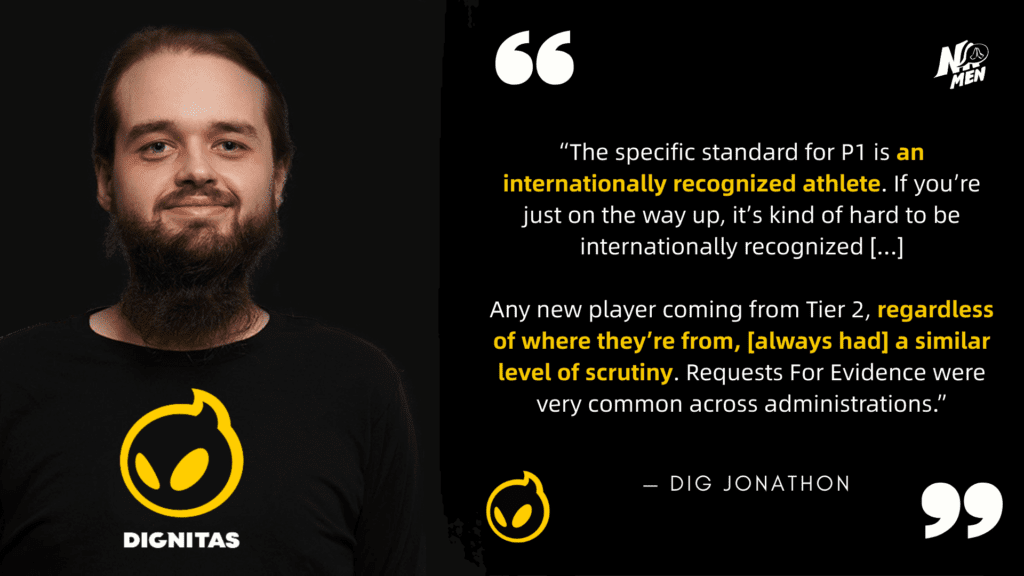
DIG Jonathon: “If you’re just on the way up, it’s kind of hard to be internationally recognized.”
Jonathon: I think it’d be best to start with an explanation of how visas work in the LCS.
So, off the bat, the P1 visa process is pretty similar to a lot of the employer-sponsored visas — you kind of make a petition (that’s you filling in a big form). That [has] letters and stuff that say, “Here’s why I qualify. Here’s proof that I qualify.” There’s like links and sources and all these kinds of things.
It’s […] a dozen pages of documents, effectively. You send that into the government and — back in the old days — if you paid for premium processing (which most teams kind of have to, [or it] takes way too long), you’d get [a response in] 14 days.
Let’s say you send it in on a Monday, [and it’s received] on a Tuesday. 14 days after that, you’d get a response. Nowadays, it’s 14 business days — which is a very significant increase in time. It’s practically a month.
It’s really bad, especially because the period between the free agency and when we’re signing people — even if you sign people within a few days of free agency — you’re right up against Thanksgiving, Christmas, New Years as like three different. If none of those land on the weekend, that’s 3 less days of processing time on your visas. It can really stack up quickly.
I think the vast majority of [delays] in the LCS fall into the category of that initial application — you get all your paperwork together, you get all your ducks in a row, you submit it, you wait [out] the 14 business days, you’re already a good chunk of the way into December. And then you get your approval.
The next step is to book a consular appointment — unless your player is Canadian.
The consular appointments [use] this online system; [you] fill in more forms and documents — as with most things. Then you get an appointment where you have to physically show up at an embassy outside of the US to surrender your passport [and] give them all the documents that you applied with. And they kind of double check that, make sure that you’re the person you say you are, that everything lines up. […]
If approved at that appointment, they hold onto your passport, […] put a big visa in it, and then give it back to you some amount of days later. Depending on where you are, there’s [variable] delays in that process — for most people, the consular appointment is actually the problem. That’s what we ran into.
We had people approved in, like, December and the first week of January — but the first consular appointments available were at the end of January or early February. In the case of Australia, it was exceptionally bad. They have 3 different consular offices: [Perth and Sydney], which were the two we initially tried, because one of them was local for FBI, [and] they were both completely slammed until March, […] Melbourne had a few in February.
We had to submit emergency requests, being like, “Hey, the games are going to start soon. We really need an early appointment. It’s super important.” We managed to get those approved, but even the earliest emergency appointments were end of January.
It came down to refreshing the page every day, hoping that someone cancels their appointment and their old date became available in the system again — which is where we got kind of lucky, getting FBI [an appointment]. That was our situation for most of the [Dignitas] people.
Obviously, there’s all sorts of other operational slowdowns that can happen. […]
For a long time, there was a way to kind of cheese the system, where you could pick whatever embassy you wanted in the world [for the consular appointment.
Q: Exactly — I’ve heard of this. Can’t you just fly to any consulate in the world to get this done quickly?
Jonathon: Yeah. So initially, fun fact, back on Golden Guardians — when we first brought FBI into the country for his first visa — I’d recently just been staying at my grandparents’ house in Vancouver before moving back to the U.S.
We needed to go to some consulate, somewhere. So we’re like, “Screw it. Let’s just go back to Jon’s grandma’s house and just hang for a few days in Vancouver, do the consulate for the U.S. in downtown Vancouver, wait a couple of days, and then just go right back to LA. Super close, super easy.”
Back then, you could just do that.
Unfortunately, recently — I think within the last year or so — they’ve [imposed] some new rules for each of the consulates to be like, “You guys gotta stop letting people from other countries just globetrot [for] embassies, because we don’t like that anymore.”
So now, there’s a very big [rush] to go to the [consulate] in your country of residence, which [creates] a bunch more traffic at those. I think part of it, obviously, [was] recent political stuff around like H1Bs and other types of visas being restricted — […] then everyone starts to swap visas, which means more visa appointments get scheduled.
It really starts to add up in certain places. Like I know Australia has an E3 visa, which is [like an] H1B kind of style thing. That’s, I think, probably part of why there’s so few appointments in Australia. […]
We ran into [problems] where teams had used those strategies in the past — going to consulates that aren’t in your home country — then the [players’] accounts then got locked once the mandate came in.
We had to message people to be like, “Hey, this person got their visa not [outside of] their home country. Now they’re region locked to the country they previously got it in, but they’re not supposed to be going there anymore. Can we change that please?”
[That] added a lot of extra time to things — […] there’s a lot of stuff going on with visas. They’re not easy. That’s why lawyers exist.
The other really common one — and this is something I’ve also experienced on a previous team, so I can kind of speak to the nuances of it — is what’s called a Request For Evidence, which is kind of the nice way of the government saying no without all-the-way saying no.

So when I was on Golden Guardians, we filed for a visa for Chime back in the Academy system and we received a Request For Evidence, which basically says like, “Hey, we don’t think you met the criteria. Here’s the specific areas we thought that your application [didn’t meet the] requirements” — or whatever complaints they particularly had with your petition.
You kind of get a chance to speak to it; prove that, in fact, you do meet the criteria, that you are eligible for the visa. Unfortunately for Chime, when we did that response, we did [our normal response] and they still said no.
If that happens, you actually get a denial — that means, the next time you go to apply for a visa, you have to say “Yes, I’ve been denied a U.S. visa before,” which then adds an extra layer of scrutiny onto any subsequent visa applications.
So for Chime, it basically took me having some understanding of this process and the legality of it all — while not being a lawyer — […] to formulate a plan with what I knew.
We needed expert letters, but we needed expert letters that spoke to very specific parts of his case that were weak — so that we could then get it approved. We got three to five expert letters that we worded very carefully with the experts.
These would be like former coaches of teams that could speak to the skill of the player, people in the media that could speak to how prolific, popular, and famous the person is, people who run sports stats websites or other similar platforms that can be like, “Hey, here’s their metrics compared to other people in this league.”
You can speak to the [players] they’ve competed with and against, and show that [they’re] internationally recognized — [players] who’ve gone to Worlds or whatever, and are now in this lower level of play. […]
You can start building those kinds of arguments; where a layperson could read this and understand like, “Oh, this player is better than these people who have traveled the world and competed at the highest level. I’m starting to understand who this person is in the grand scheme of things.”
But obviously nowadays that is a much harder thing to do because frankly there’s just a lot less overlap between Tier 2 and [those players]. There’s also just less events in general and less time spent on it.
It’s a much more difficult sell for a lot of these young players coming up from Tier 2.
Q: So a player’s first P1 — before they’re established — is the hardest to secure?
Jonathon: Yeah, exactly. The specific standard for P1 is an internationally recognized athlete. So if you’re just on the way up, it’s kind of hard to be internationally recognized when you haven’t been in the LCS traveling, getting the opportunity to go to events.
[The LCS] is kind of the level you need [to access] that international competition.
The only international competitions you’re getting are like the few times where Tier 2’s from other regions will compete against each other — or maybe you’ll go and play abroad somewhere in Europe or something.
That’s where you start to get those opportunities to pad that part of your resume out. And so if you’ve only played within the Tier 2 of North America, you really do need to make a pretty compelling legal case.
Q: If they go to Korea or Europe and hit Rank 1 while streaming and building a fandom, does that gain them prowess as an athlete for the P1?
Jonathon: The hard part is the things that we consider valuable aren’t necessarily considered valuable to USCIS or border officer who’s going through the paperwork.
For us, going to Korea and being high on the ladder would be impressive. To them, you’re playing an online video game. You’re not in organized competition. There’s no sport element happening. “”
There’s interpretive elements to it — if the person reviewing the petition has seen a lot of P1s before and kind of gets it, they might approve it more easily. But if you get someone who hasn’t gone through this as much — or applies a higher level of scrutiny — you might just end up on the wrong side of the lottery.
For Zamudo specifically, playing in LTA South in that relegation defense stuff definitely helps. Playing internationally anywhere outside of North America is a nice thing to put on the resume.
If he was denied before, that definitely makes any subsequent applications much harder. Once you get that first denial, you really need to step up your game on the reapplication. Measure three times, cut once. Because the more denials you pile up, the harder it gets.
Q: So how much of this is politics versus just the system itself?
Jonathon: In my experience, any new player coming from Tier 2, regardless of where they’re from, has a similar level of scrutiny. Requests for evidence were very common across administrations.
A lot of Canadian Tier 2 players were in the same boat; it was always difficult. […]
That’s why I wanted to speak about the visa process in general. A lot of people were like, “Why is it so hard for FBI to get a visa?” — well, he got approved weeks ago. There’s just all these extra steps.
FBI actually entered the country [Tuesday] morning. He’s finally here and good to go. IgNar’s passport have [arrived early Wednesday morning]. He should be here for the weekend.
Most of our folks are trickling in now. We’re maybe a week off from where we wanted to be, but [at] similar pace to everyone else.
[In terms of the politics], for P1s, there’s no quota — it’s a very narrow category. A kid from Canada who’s played NACL for a few years has a much smaller resume pile, and it’s easier for someone to just say no.
At lower levels of competition, media presence is more sparse — that adds another barrier. It’s the same with niche sports. You really have to show why this thing exists and matters.
Q: Anything else you wanted to say?
Jonathon: No, I just want to educate the average fan so they can be more understanding of what’s going on. […]
I’m not a lawyer. I’ve just gone through this process many times and worked with many different lawyers. It’s an imperfect system; it’s slow and clunky.
The biggest pain is that free agency is so close to the start date with so many holidays [in between]. The business days make it really tough.